
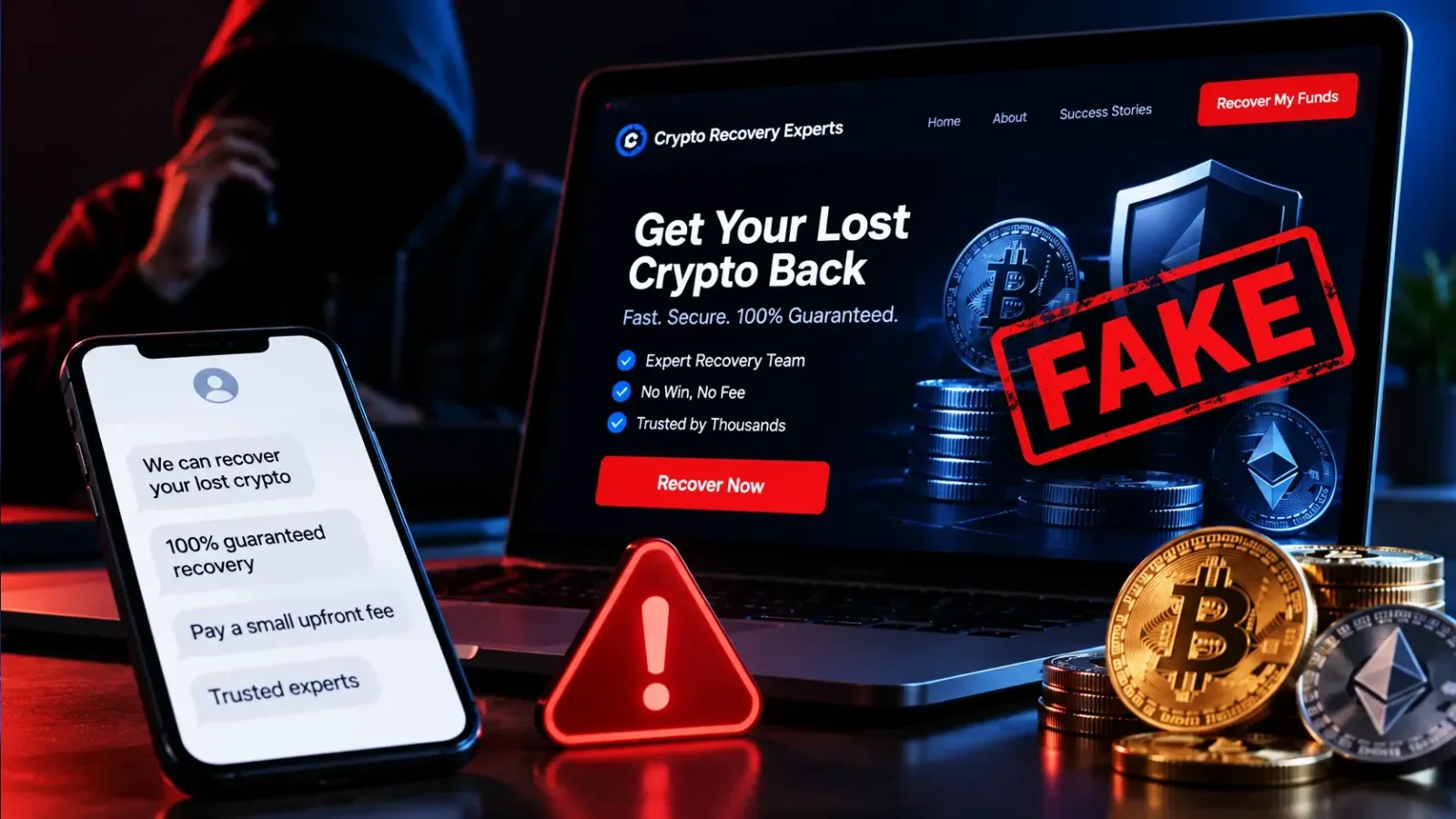
After losing money to a crypto scam, many people are contacted again. The message sounds like the help they have been hoping for: a law firm that has “located your funds”, a government department with a “victims’ compensation list”, a blockchain investigator who can “trace and reverse” the transfers. All they need is a fee to get started.
Very often, this is a second scam aimed at people who have already lost money. The FBI calls these recovery scams, and in 2025 people reported more than 10,500 of them to its Internet Crime Complaint Center, with reported losses of $1.4 billion (a figure that can include the earlier losses that led to the recovery contact). This guide explains how they work, the disguises they use, and how to check anyone who offers to help.
Key takeaways
- Government agencies and law enforcement never charge victims to investigate a crime or return money.
- Nobody can guarantee to recover crypto. A promise to do so is itself a warning sign.
- Unsolicited contact from someone offering recovery, especially if they already know details of your loss, should be treated as a scam until proven otherwise.
- Verify anyone who contacts you yourself, using contact details you look up independently.
- If you’ve already paid a recovery service, act quickly: call your bank and report it.
How Recovery Scammers Find You
The FTC explains that scammers buy and sell lists of people who have already lost money, sometimes called “sucker lists”, and contact them again. The Canadian Anti-Fraud Centre describes the same thing: fraudsters keep lists of previous victims and reach out claiming they can return the money, for a fee.
Others don’t wait to be found. They advertise “crypto recovery” online and build websites that look like established firms. The FBI notes that in some cases victims have contacted fraudsters themselves, through fake websites that appear legitimate.
The most convincing approaches use details of your loss. The FBI warns that recovery scammers may know the amounts, dates and company involved in your earlier transfers.
The Disguises They Use
The Fake Law Firm
The FBI has issued repeated warnings about fictitious law firms targeting crypto scam victims. They contact people through social media and messaging apps, claim to have information on their case from the FBI, the Consumer Financial Protection Bureau or another agency, and send documents with real law firms’ names and letterheads. Some direct victims to open an account at a foreign bank with a convincing but fake website, or add them to a WhatsApp group with supposed “bank processors” and attorneys who demand fees to verify identity before funds can be released.
The Fake Government Agency
Scammers impersonate real agencies, such as the FBI or the Canadian Anti-Fraud Centre, using stolen logos and spoofed phone numbers. Some invent agencies that don’t exist: the FBI cites one calling itself the “International Financial Trading Commission (INTFTC)”. A common line is that you are on a government list of scam victims and can recover your funds through “legal channels”.
The FBI is direct about this: there are no law firms that are officially authorized partners of US government agencies, and the government does not ask for payment for law enforcement services.
The “Blockchain Investigator” or “Ethical Hacker”
These offer to trace your crypto and “hack it back” or “reverse” the transaction. Real blockchain analysis can show where funds went, but it cannot pull them back out of someone else’s wallet. Getting money back depends on law enforcement or a court acting against an exchange or company that holds the funds. Our guide can scammed crypto be recovered? explains how that actually works.
The Original Platform’s “Compliance Department”
Sometimes the recovery offer comes from the platform itself, or from a “regulator” it sends you to: your account has been found, your funds are ready, there is just a tax, a clearance fee or a penalty to pay first. This is the same pattern as being asked to pay before you can withdraw.
Red Flags Checklist
Drawn from the FBI’s and FTC’s published warnings. One of these should make you stop; several together almost certainly mean a scam.
- They contacted you first, out of the blue, offering to recover your money.
- They want a fee upfront: a retainer, processing fee, tax, insurance or “verification” payment.
- They want payment in crypto, gift cards, wire transfer or a payment app, or to a third-party company “for safety”.
- They promise or guarantee recovery.
- They say they are partnered with, or were referred by, the FBI, CFPB, SEC or another agency.
- They know details of your loss that you haven’t told them.
- They say you are on a government list of victims.
- They won’t appear on video, won’t meet, or can’t show a licence or bar membership you can verify.
- They move you to WhatsApp or Telegram, or into a group chat with “bank officers” or “processors”.
- They ask you to open an account at a foreign bank, or for your bank login, Social Security number or ID documents to “verify” you.
- They offer a refund cheque for more than you lost and ask you to send back the difference.
How to Check Anyone Who Offers to Help
Assume nothing, verify everything
The FBI recommends a “zero trust” approach: verify every request and trust no one by default, however official the letterhead looks.
Contact the organization yourself
Look up the agency or firm’s official phone number yourself, not the one in the message, and ask whether the person and the case are real. For anyone claiming to be the FBI, contact your local FBI field office.
Check the lawyer is licensed
In the US, look the lawyer up in the state bar’s directory. In Canada, use the provincial law society’s directory. Then contact the firm through the details listed there. The FBI suggests asking for video verification and proof of licence, and treating a firm that won’t provide them as illegitimate.
Search their name with the word “scam”
The FTC suggests searching the organization’s name with words like “complaint” or “scam” before you engage.
Keep a record of everything
Save messages, emails, documents and payment requests. If it turns out to be a scam, these help the authorities.
Genuine Help Versus a Recovery Scam
Genuine lawyers do charge for their work, so a fee on its own doesn’t prove a scam. The differences are in how they behave.
Genuine help
- You found them and contacted them yourself
- Can be verified with a state bar or law society
- Meets you on video or in person
- Explains the realistic chances, including that recovery may not be possible
- Gives you a written agreement before any work
- Government agencies never charge you anything
Recovery scam
- Contacted you out of the blue
- Can’t be verified, or uses a real firm’s name with different contact details
- Avoids video and only uses messaging apps
- Promises or guarantees recovery
- Wants an urgent upfront fee, often in crypto or gift cards
- Claims to work with the FBI or another agency
If You’ve Already Paid a Recovery Service
You are not alone, and it is not too late to act. The FTC’s advice is that the sooner you act, the better, because quick action can help stop or reverse a payment.
- Stop all further payments, whatever new reason you are given.
- Call your bank or card issuer if you paid by card, bank transfer or wire.
- Report it. In the US, to the FBI at ic3.gov and the FTC at reportfraud.ftc.gov. In Canada, to the Canadian Anti-Fraud Centre at reportcyberandfraud.canada.ca and your local police. Include how they contacted you and every name, number, email and wallet address they used.
- If you gave them remote access or ID documents, change your passwords, contact your bank, and tell the agency you report to.
Then be ready for a third approach. People who have paid once are often targeted again.
Not sure whether an offer of help is genuine?
Tell us who contacted you and what they asked for. A member of our team will give you an honest view, for free.
Questions People Ask
They Knew Exactly How Much I Lost and When. How Is That Possible?
The FBI lists this as a red flag. Details of your losses can come from the original scammers, from shared victim lists, or from information you posted while looking for help. Knowing your details does not make someone legitimate.
Does the Government Ever Return Money to Scam Victims?
Sometimes. When US authorities seize criminal proceeds, the Department of Justice can return forfeited funds to victims through a process called remission. The Department states that victims are not required to pay money to take part in or receive funds from this process.
Can Blockchain Tracing Get My Money Back?
Tracing can show where funds went, which is useful evidence for law enforcement. On its own, it cannot move crypto out of someone else’s wallet. Recovery depends on authorities or a court acting against whoever holds the funds.
Is V Tech Fin a Recovery Service?
No. We review cases for free and tell people honestly what their situation most likely means and what their realistic options are. We never ask for upfront fees, never promise to recover money, and never contact people out of the blue.
This guide is general information, not legal or financial advice. See our Disclaimer.